
The Georgia Center for Facial Plastic Surgery
613 Ponder Place Drive
Evans, GA 30809
Phone: (706) 210-2625
Fax: (706) 210-9882
Monday–Friday: 9 a.m.–5 p.m.
Total VolumeLift®
Dr. Achih H. Chen, a facelift specialist near Augusta, Georgia, can address your mid-face concerns with this state-of-the-art rejuvenation technique and even enhance facelift results if you have had, or are planning to have, facelift surgery.
One of the most distinctive and defining features of the youthful face is volume. This is especially true in the mid-face region, the central area of the face between the corners of the eyes and the corners of the mouth. With age, there is a loss of volume in the mid-face due to the loss of fat. Similar to how a balloon sags as air escapes, the loss of volume in the mid-face causes the skin in the central part of the face to sag downward making the nasolabial folds or “parentheses” appear deeper.
A lifting or tightening procedure is most often thought of as the treatment for the aging face. However, the youthful face is not taut or tight-appearing and lifting and tightening will flatten and widen the mid-face, resulting in a very unnatural, “operated-on” appearance. Restoring volume creates a lifting effect without tightening, very similar to adding air to a deflated balloon. The Total VolumeLift® was developed based on this concept, lifting with volume instead of actual tightening. It is the latest innovation in mid-face rejuvenation.
It’s a technique performed by a limited number of highly trained surgeons for a refreshed, natural-appearing, youthful face. The Total VolumeLift® is often combined with the Total Lift® and the Total LaserSmooth® for the Total Face® Rejuvenation. Contact Dr. Achih Chen to schedule a consultation to discuss your facelift goals today!
The Mid-Face and Aging
The conventional wisdom is that it is the deepening of the nasolabial folds (the lines that run from the corner of the nose down to near the corner of the mouth) or “parentheses” (as referred to by injectable filler companies such as JUVÉDERM®, Restylane®, or RADIESSE®) that cause the mid-face to look aged. As a result, in addition to lifting and tightening of the mid-face, another popular solution to creating a more youthful appearing mid-face is thought to be filling of these “parentheses” using various methods including injectable fillers.
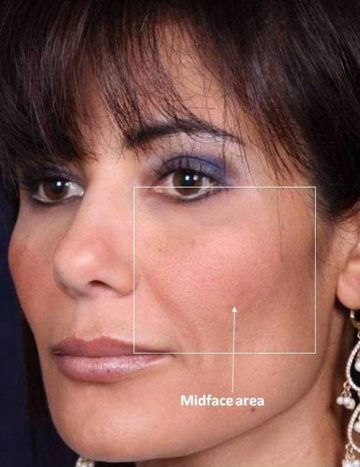
The mid-face is the area of the face that lies between the corner of the mouth and the corner of the eye. It is often referred to as the cheek.
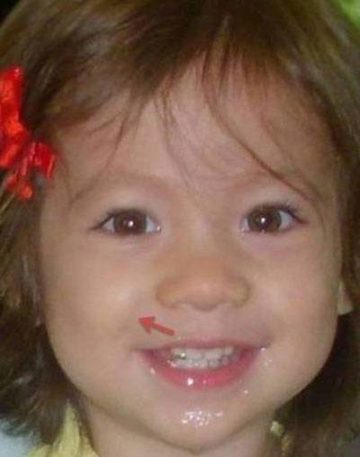
Nasolabial Fold in a 3 year old
However, on closer inspection, the nasolabial fold is present throughout life, even in the very young. The nasolabial fold is a normal anatomical structure that deepens during smiling. The nasolabial fold or “parentheses” only appear deeper in the aging face as the mid-face deflates and the overlying skin sags downward similar to a deflating balloon.

Volume loss in the mid-face results in sagging of the skin and deepening of the nasolabial folds
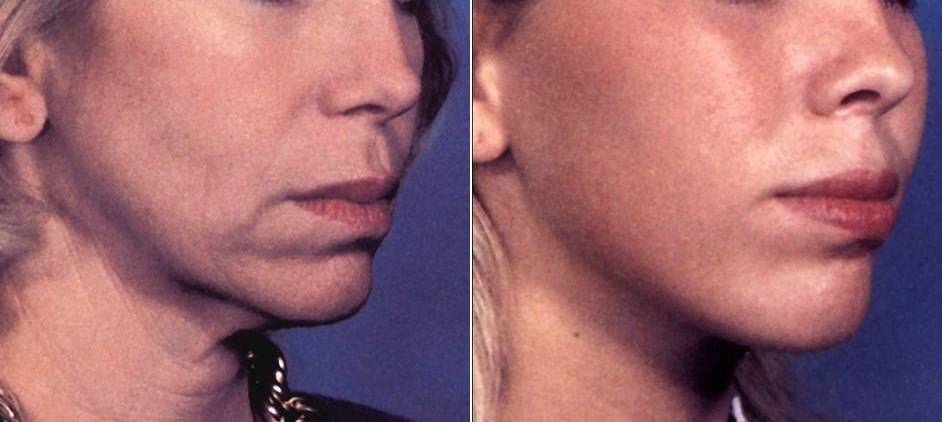
The daughter (right) has much more volume in the mid-face than her mother (left)
In comparing a youthful face and an aging face as demonstrated in the photographs comparing a mother and her daughter, the most obvious difference in the mid-face region is not the presence or absence or depth of the nasolabial fold, but instead the fullness of the mid-face. The Total VolumeLift® is based on this very important concept in which the youthful mid-face has volume. Restoring this volume in the aging mid-face creates a lift without tightening, creating a natural-appearing, facial rejuvenation.
Rejuvenating the Mid-Face vs Rejuvenating the Jawline and Neck
When Dr. Chen compared youthful faces with aged faces, he found that 3 main problems affect the aging face. First, the jaw and the neckline sag resulting in jowls and a neck wattle. Second, the middle portion of the face, commonly called the cheeks or mid-face, loses volume and deflates very much like a balloon losing air. And third, the smooth texture of youthful skin changes to form creases and become cobblestone-like.
Traditionally, tightening procedures using variations of facelift techniques were the go-to solution for restoring a more youthful face in the minds of both surgeons and patients. However, lifting and tightening only works well in the jawline and neck region. Attempting to use this type of technique to rejuvenate the mid-face area can result in a very unnatural-appearing, widening and flattening of the cheek area.
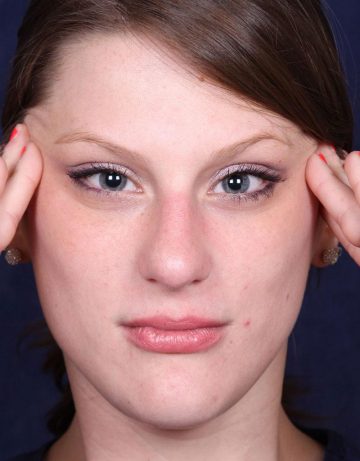
Lifting and tightening of the mid-face results in an unnatural widening and flattening of the cheek area
In the long term, this surgically-altered widened and flattened mid-face sags downward, forming an equally unnatural-appearing sagging, swept appearance even when heroic attempts are used to pull the mid-face tight.
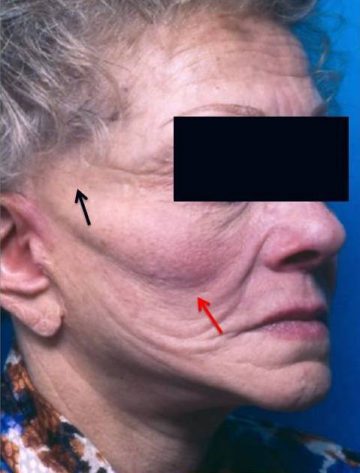
Unnatural appearance that results in the long term from lifting and tightening the mid-face during facelift surgery. This is an individual who had surgery at another center. (Black arrow–over lifted side burn, red arrow–sagging of the mid-face)
The lifting effect of the mid-face from the volume restoration of the Total VolumeLift® creates a much more natural appearing rejuvenation as it recreates the fullness so characteristic of the youthful face.
*Individual results and recovery may vary.
**This is a patient of Dr. Achih H. Chen who has given consent to use these photos.
Mid-Face Rejuvenation, Mid-Face Implant Procedure, Mid-Face Fat Grafting
In its original design, the Total VolumeLift® is performed using a type of implant that is placed below all of the soft tissue layers of the mid-face region and against the bone. After the implant is placed in this location and the patient heals, the implant is nearly impossible to feel.* That’s true even of a trained examiner such as a physician. The soft implant is made of Silastic®, a biologically compatible material that has a very long track record of safety. The implant is customized during the operation to augment the optimal areas to restore the lost volume in the mid-face and the natural fullness of a youthful face.
The implant is placed through a small, 2-centimeter incision hidden inside the mouth. The implant is fixed to the underlying facial bone in the mid-face region. Unlike traditional cheek implants, the Total VolumeLift® implant is designed to restore volume where fullness has been lost with age. This lost volume is more towards the middle of the face rather than further laterally where the “cheek bones” lie. As a result, the Total VolumeLift® implant is not designed to create higher “cheek bones” like cheek implants. The Total VolumeLift® implant is also unlike a breast implant in that it is not a “floating” implant. As breast implants must be mobile to simulate a natural breast, they can be seen and felt. The Total VolumeLift® implant is fixed to the underlying facial bone. Consequently, they do not move and are virtually undetectable once healing has occurred.*
In designing the Total VolumeLift®, Dr. Chen and his team of researchers from the Augusta University and Duke University used intra-operatively customized implants to restore lost mid-face volume due to the great advantages over other methods available. These implants could be customized to each individual, they are predictable in size, they can be switched to another size to accommodate an individual’s evolving desires for the amount of mid-face fullness, and they are completely reversible in the unlikely event that the restored volume is no longer desired.
Although there are many advantages to using implants for the Total VolumeLift®, Dr. Chen and his research team have an alternative design to achieve a very similar volume restoration of the mid-face using fat grafting. In this version, the fat to be used is most commonly harvested from the lower abdomen through a small incision hidden on the lower part of the umbilicus or belly button. The fat is grafted to the mid-face region in a distribution customized to each individual’s needs to restore the youthful volume of the mid-face.
Total VolumeLift® Recovery — Mid-Face Rejuvenation, Implant Recovery
The Total VolumeLift® is performed using intravenous (IV) sedation in which individuals are completely unaware of their environment. The post-operative nausea and sore throat that may accompany general anesthesia is usually avoided with surgery performed under intravenous sedation. Following the procedure, patients will notice 2 small incisions inside the mouth between the gums and the upper lip. Rinsing the mouth following meals is recommended to quicken healing of the incision. Head elevation and post-operative icing of the surgical site will also limit swelling following the procedure. There is minimal post-operative discomfort. Light activities may be resumed a few days following surgery. If discretion is desired, individuals should plan to take at least 1 week before returning to work or other public outings.*
The recovery is similar for individuals choosing fat grafting instead of an implant for their Total VolumeLift® procedure, with the exception that there will be a compression garment placed around the fat donor site. This may be removed 48 hours following the procedure. There is not an incision within the mouth. As a result, rinsing the mouth following meals is not required.
Achih H. Chen MD, FACS
Award-winning facial plastic surgeon
Dr. Chen is a double board-certified, fellowship-trained facial plastic surgeon who's been chosen for Castle Connolly's Top Doctors® Award, a prestigious honor recognizing the top 1% of physicians in the U.S.
Alternatives to Total VolumeLift® Implants for Mid-Face Rejuvenation
While the Total VolumeLift® was originally designed using an intra-operatively customized implant for rejuvenation of the mid-face region, some are hesitant to have implants. For these individuals, fat transfer or fat grafting remains a very attractive alternative. Fat may be used to re-volumize the deflated aging mid-face instead of implants. Although most aging faces undergo volume loss, a small number of individuals experience minimal loss of volume of the mid-face with aging. Instead, the mid-face only falls or sags. In these individuals, the mid-facelift may be a more appropriate procedure.
Please note, the Total VolumeLift® implant is not a cheek implant and a cheek implant is not a Total VolumeLift® implant. The Total VolumeLift® implant restores the volume of youth, while the cheek implant is designed to alter the underlying facial bone structure to create more prominent cheeks or higher cheek bones.
Total VolumeLift® — Mid-Face Rejuvenation Before-and-After Photos
Please browse our Total VolumeLift®/Mid-Face Rejuvenation gallery to see the natural, refreshed appearance that can be achieved through volume restoration by our award-winning facial plastic surgeon, Dr. Achih H. Chen. Unlike some surgeons who display only stock photographs of post-operative results, all of our gallery photographs are taken of actual patients who had surgery performed by Dr. Chen. These are only a few of the photographs released with patient consent; each showcases a particular aspect of the surgeries performed by Dr. Chen. If you have a specific topic of interest or concern, please contact us at The Georgia Center for more information about the Total VolumeLift®.
Contact Our Facial Plastic Surgeon
Patients often travel from Columbia or Charleston, SC, and throughout the Atlanta metro area, to have Dr. Chen perform the Total VolumeLift®. He can help you restore volume to those fallen cheeks and mid-face to take years off your face and provide you with the fullness of a youthful face. You can enhance a facelift procedure with the Total VolumeLift® mid-face rejuvenation.
Request a consultation to meet with Dr. Chen using the online form, or call our office at (706) 210-2625 to schedule an appointment.